AI Trading Tools vs Traditional Screeners: What Actually Works for Indian Traders (2026)
Team MarketNetra
3 April 2026
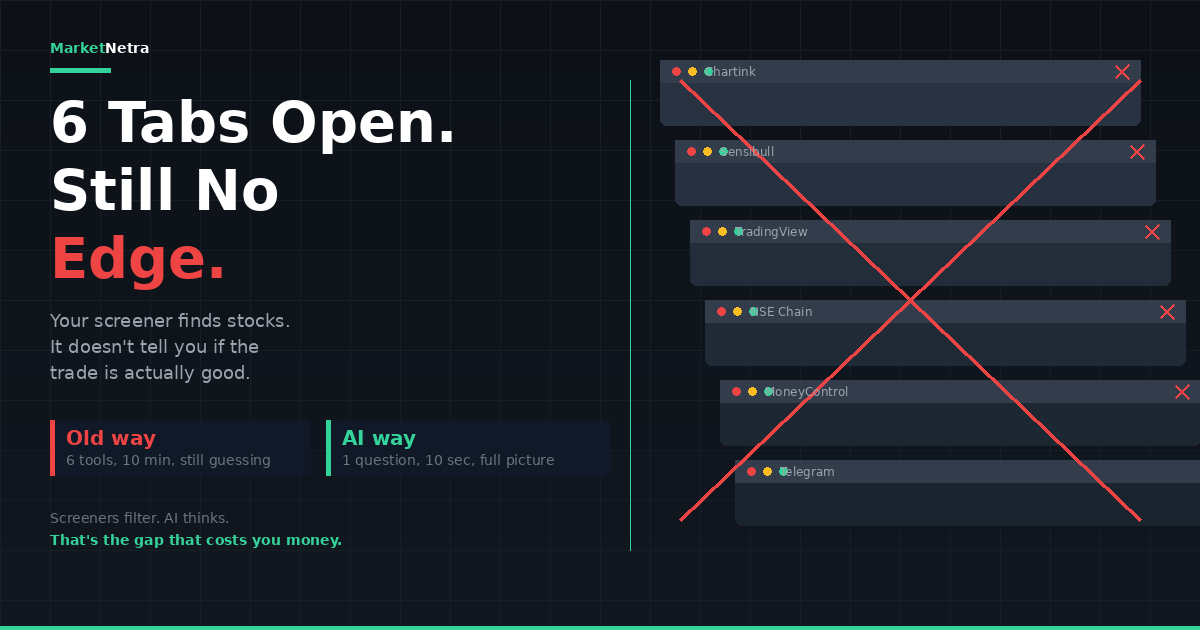
Every Indian trader has a stack. Chartink for scanning breakouts. Sensibull or Opstra for options strategy building. Screener.in for fundamentals. TradingView for charting. NSE website for the option chain. MoneyControl for news. Maybe a Telegram group or two for "tips."
That's six tools, six tabs, six different data sources — and none of them talk to each other.
You spot a bullish breakout on Chartink at 10:15 AM. You switch to TradingView to confirm the chart. Then you open the option chain to check OI positioning. Then you check FII/DII data on a fourth tab. By the time you've synthesised all of this, it's 10:28 AM. The stock has already moved 2%. Your edge evaporated while you were tab-switching.
This is the fundamental difference between traditional screeners and AI trading intelligence tools — and it's not the difference most people think it is.
What Traditional Screeners Do Well
Let's be fair to the tools that built the foundation for Indian retail trading. They earned their place for good reason.
Chartink is excellent at what it does — scanning stocks based on pre-defined technical conditions. You set your RSI range, your EMA crossovers, your volume thresholds, and it spits out a list of stocks that match. For traders who know exactly what pattern they're looking for, Chartink is fast, free, and reliable.
Sensibull transformed options trading for Indian retail participants. Before Sensibull, building a multi-leg options strategy meant manual calculations on a spreadsheet. Its strategy builder, payoff visualiser, and live Greeks display brought institutional-grade options tools to a ₹499/month price point.
Opstra goes deeper on the analytics side with backtesting capabilities, historical IV data, and more granular Greeks analysis. It's built for traders who want to test a strategy against historical data before deploying capital.
Screener.in is the go-to for fundamental screening — filtering companies by PE ratio, ROE, debt-to-equity, promoter holding changes, and quarterly results.
TradingView needs no introduction. Its charting is best-in-class, the Pine Script community is massive, and the social features add a layer of crowd-sourced analysis.
Each of these tools is good at one thing. That's exactly the problem.
The Fundamental Limitation: Screeners Filter, They Don't Think
A traditional screener answers one question: "Which stocks meet these specific criteria right now?" It returns a list. A filtered, sorted list.
What it cannot do is tell you why a stock that passed your filter might still be a bad trade today. It doesn't know that FIIs were net sellers of ₹4,000 crore yesterday. It doesn't know that the option chain shows heavy call writing at your target level. It doesn't know that India VIX spiked 12% in the last session, suggesting the breakout might be a volatility trap rather than a genuine move.
Screeners are stateless. They have no memory of what happened yesterday and no ability to cross-reference what's happening across data sources right now.
This is the core gap. SEBI's data tells the story of the consequences: 91% of individual F&O traders lost money in FY2024-25, with net losses of ₹1.06 lakh crore. Meanwhile, the CFA Institute noted that 97% of FPI profits came from algorithmic systems that process multiple data dimensions simultaneously — price, volume, OI, flows, sentiment — in real time.
The losing traders had access to the same screeners. The same charts. The same option chain data. What they lacked was the ability to synthesise it all fast enough to matter.
What AI Trading Intelligence Tools Do Differently
AI intelligence tools don't replace screeners. They sit on top of everything screeners do and add three capabilities that change the game entirely.
1. Multi-Source Synthesis in Real Time
When you ask an AI trading tool "Should I buy the NIFTY 24,000 CE right now?", it doesn't just check the price chart. It simultaneously evaluates:
- The current NIFTY trend and key support/resistance levels
- The option chain positioning at and around the 24,000 strike (OI buildup, changes, volume)
- The put-call ratio trend over the last few sessions
- Today's FII/DII activity and whether institutional flows support the direction
- India VIX levels and what they imply about premium decay
- Whether sector rotation supports the broader move
A human trader doing this manually needs to check four or five different platforms. An AI tool pulls from all these sources and gives you a synthesised answer in seconds.
This isn't a marginal improvement. It's the difference between making a decision based on one signal versus making a decision based on six correlated signals.
2. Natural Language Interaction
Traditional screeners require you to speak their language. You need to know how to construct a scan query: RSI(14) < 30 AND Close > EMA(20) AND Volume > Volume SMA(20,1.5). If you don't know what these parameters mean or how to set them correctly, the screener is useless.
AI tools let you speak in the language you actually think in:
- "Which F&O stocks are showing strength today with institutional buying?"
- "RELIANCE is near its all-time high — is the option chain supporting a breakout?"
- "What's the best options strategy given current VIX levels?"
These aren't just convenient phrasings. They capture trading intent in a way that a screener query never can.
3. Context-Aware Analysis (Not Just Filters)
A screener tells you that HDFC Bank crossed its 200-day moving average today. That's a data point.
An AI tool tells you that HDFC Bank crossed its 200-day moving average, but the banking sector overall is showing weakness, FIIs sold ₹1,200 crore in banking stocks yesterday, the option chain shows heavy call writing at the next resistance, and the last three times this crossover happened during a weak sector backdrop, the stock pulled back within five sessions.
This is the difference between filtering and thinking. Screeners filter. AI contextualises.
The Honest Comparison: Where Each Tool Type Wins
This isn't a one-replaces-all situation. Here's where each category genuinely excels.
Traditional screeners win when:
- You need to scan 200+ F&O stocks for a specific technical setup in seconds
- You need historical backtesting of a specific strategy (Opstra, AlgoTest)
- You need precise options payoff simulation for a multi-leg position (Sensibull)
- You need fundamental data filtering (Screener.in)
AI intelligence tools win when:
- You need to synthesise multiple data sources into a trading decision
- You need context around a screener's output — the stock passed your scan, but is the trade actually good right now?
- You want the option chain, FII data, and technical picture in one answer instead of five tabs
- You're in a live position and need an objective, unemotional read on what's changed
The smart approach is using both. Use Chartink to generate your initial watchlist. Then use an AI tool to validate each candidate against the full data picture before you trade. Use Sensibull to construct your options strategy. Then ask an AI tool whether the OI structure and flows support the directional bet you're making.
Why This Gap Exists in India Specifically
The Indian market has a unique characteristic that makes AI synthesis particularly valuable: the sheer density of actionable data updated in real time.
NSE publishes live option chain data every few seconds. FII/DII figures come daily. India VIX updates continuously. Sector indices move independently. And with 200+ F&O stocks, the number of OI datapoints to track at any given moment is in the tens of thousands.
In the US, much of this data is paywalled or delayed for retail traders. In India, it's free — NSE puts it all on their website. The bottleneck was never access. It was always processing capacity.
A study by PiP World analysing 275 million trades found that 85% of failed trading accounts followed the same four-phase behavioural spiral, with the critical failure point being the execution stage — where emotion overcomes analysis. The conclusion: traders don't need to become emotionless; they need to stop managing the part of the process where emotion does the most damage.
AI trading intelligence tools directly address this by making thorough analysis faster than emotional reactions. When you can get a synthesised view of the option chain, FII flows, and technical picture in 10 seconds, the window for emotional decision-making shrinks dramatically.
What to Look for in an AI Trading Tool
Not every tool labelled "AI" deserves the name. Here's how to evaluate whether a tool offers genuine AI intelligence or just a screener with a chatbot skin.
Genuine AI tools:
- Pull from multiple data sources simultaneously (price, OI, flows, volatility)
- Provide contextual answers that change based on current market conditions
- Can handle nuanced questions that require synthesis across data types
- Give you the reasoning behind their analysis so you can validate it
Repackaged screeners:
- Only filter based on pre-set technical conditions
- Give the same type of answer regardless of market context
- Can't cross-reference option chain data with institutional flows
- Produce output that looks like a formatted scan result, not a contextual analysis
The Bottom Line
Traditional screeners gave Indian retail traders access to institutional-grade data for the first time. That was revolutionary — and those tools still work for what they were built to do.
AI trading intelligence tools solve the next problem: what to do with all that data once you have it. The challenge for the Indian retail trader in 2026 isn't finding data. It's drowning in it. Six tabs, six tools, six different pictures of the same market — and somehow needing to make a single coherent trading decision before the opportunity disappears.
The traders who are adapting aren't choosing between screeners and AI. They're using screeners to find candidates and AI to make decisions. It's the difference between having a telescope and having a telescope with someone who knows where to point it.
For nine out of ten F&O traders in India, the current approach isn't working. The data is right there. The tools are right there. What's missing is the synthesis layer that turns noise into clarity, fast enough to actually trade on.
That layer is AI. And it's not coming — it's already here.
Sources & Citations
- SEBI Study (July 2025) — 91% of individual traders lost money in F&O in FY24-25; net losses of ₹1,05,603 crore.
- CFA Institute Market Integrity Insights (November 2025) — 97% of FPI profits came from algorithmic trading systems.
- RSIS International (2025) — 46.8% of variance in investment decisions explained by behavioural biases; loss aversion strongest predictor.
- PiP World / Hedge Fund Alpha (November 2025) — 275 million trades analysed; 85% of failed accounts followed identical four-phase behavioural spiral.
- Moneylife (December 2025) — ₹1.06L crore individual F&O losses confirmed in Parliament.
For educational purposes only. Not SEBI-registered investment advice.
Ready to trade smarter?
Get AI-powered market analysis for NIFTY, BANKNIFTY, and 200+ F&O stocks.
Start for ₹1 →