How AI Trading Intelligence Tools Can Help You Trade Better — And Why Indian Traders Need Them Now
Team MarketNetra
5 April 2026
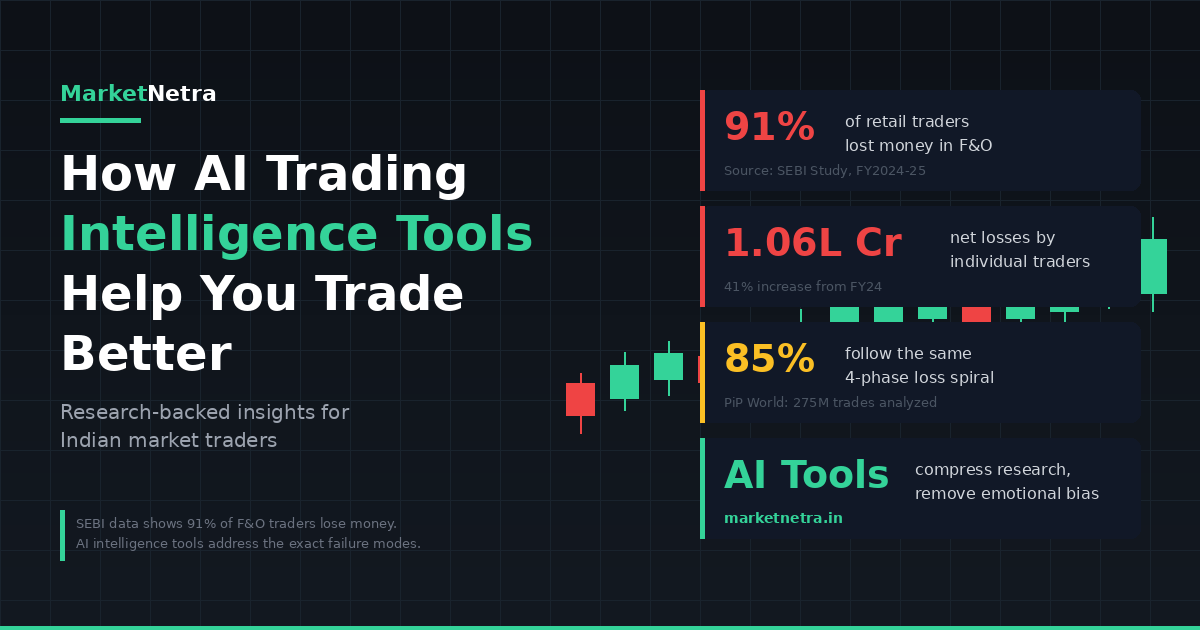
The numbers are brutal and impossible to ignore. According to SEBI's July 2025 study, 91% of individual traders in India's equity derivatives segment lost money during FY2024–25. The collective net losses? A staggering ₹1.06 lakh crore — up 41% from the previous year. The average per-person loss stood at ₹1.1 lakh. Nearly 96 lakh unique traders participated, and nine out of ten walked away poorer.
These aren't abstract statistics. Behind every data point is a real person — someone who opened a Zerodha or Angel One account hoping to build wealth, only to watch their capital evaporate in the F&O segment. As the CFA Institute noted in its November 2025 analysis of SEBI's data, institutional investors are consistently gaining at the expense of retail participants, with 97% of FPI profits and 96% of proprietary trader profits coming from algorithmic trading systems.
The question is no longer whether retail traders need help. The question is what kind of help actually works.
The Real Enemy Isn't the Market — It's Your Own Brain
Before we talk about AI tools, we need to understand why traders lose. It's not because they lack access to charts, indicators, or data — there has never been more free market data available than there is today. The problem runs deeper.
A meta-analysis published by Emerald Publishing in 2024 examined 31 empirical studies on emotional biases in investing. The findings were stark: loss aversion showed the strongest correlation with poor investment decisions (r = 0.492), followed by regret aversion (r = 0.401) and overconfidence (r = 0.346). In plain terms, the emotional pain of losing money distorts your decision-making far more than the pleasure of making money improves it.
A 2025 study of retail investors in Bengaluru confirmed this at a local level: loss aversion emerged as the single strongest predictor of irrational investment decisions, followed by herding behaviour and overconfidence. About 46.8% of the variance in investment decisions could be explained by behavioural biases alone.
Research published in 2025 found that overconfident traders trade approximately 45% more frequently than they should, eroding annual returns by 1–3% through excessive transaction costs alone. When you add the emotional spiral of revenge trading and FOMO, the picture gets worse.
A landmark study by PiP World, analysing 275 million trades across 8 million trader accounts, found something chilling: 85% of failed accounts followed the exact same four-phase behavioural spiral — cautious early success, overconfidence formation, catastrophic loss, and terminal decline. The pattern repeated with clockwork precision across geographies and asset classes.
This is the core problem AI trading intelligence tools aim to solve — not by predicting the market, but by interrupting the human tendencies that destroy trading accounts.
What AI Trading Intelligence Actually Does (And Doesn't)
There is a critical distinction that gets lost in the marketing hype. Most of what's marketed as "AI" in trading isn't artificial intelligence at all — it's clever branding wrapped around the same rules-based systems traders have used for decades.
Real AI trading intelligence operates differently. It uses machine learning to process vast amounts of data — price action, volume, open interest, institutional flows, sentiment — and synthesise it into contextual insights that would take a human hours to compile manually. The key word is "assist." The AI handles data-intensive tasks while the human makes final decisions.
Here's what genuinely useful AI trading intelligence tools do for retail traders:
They compress research time dramatically. What used to require toggling between NSE's option chain page, MoneyControl for FII/DII data, TradingView for charts, and Twitter for sentiment can now happen in a single query. Instead of spending 45 minutes before market open piecing together a picture, you get a synthesised view in under a minute. For a working professional who trades on the side — and that's most Indian retail traders — this time compression is transformative.
They remove the emotional lens from data interpretation. When you're sitting on a losing BANKNIFTY position and the market ticks against you, your brain is physiologically incapable of objective analysis. Cortisol floods your system, and the prefrontal cortex — responsible for rational decision-making — literally shuts down. An AI tool doesn't have cortisol. It looks at the same OI data, the same FII flows, the same technical levels, and gives you a read that isn't filtered through fear or hope.
They surface what you'd otherwise miss. Confirmation bias is one of the most destructive forces in trading. Once you form a directional view, your brain actively filters out contradictory evidence. AI tools don't have a directional bias. They'll tell you that FIIs are aggressively selling even when your chart setup looks bullish. They'll flag that the OI buildup at your target strike suggests strong resistance. This "second opinion" function is arguably more valuable than any predictive capability.
They democratise institutional-grade analysis. Institutions consistently profit from retail traders partly because they deploy sophisticated algorithmic systems that process data at speeds and scales humans cannot match. AI tools for retail traders don't fully close this gap, but they meaningfully narrow it. When a retail trader can instantly see the same OI chain shifts, PCR movements, and sector rotation patterns that institutional desks monitor, the information asymmetry shrinks.
What AI Trading Tools Cannot Do
Honesty matters here, especially given SEBI's regulatory environment and the responsibility that comes with building tools for a market where so many people are losing money.
AI cannot predict the future. No tool, no matter how sophisticated, can tell you with certainty where NIFTY will be at 3:30 PM today. The value comes from aggregating multiple data points and presenting probabilities — not certainties.
AI cannot replace trading discipline. If you don't have a risk management framework — position sizing rules, stop-loss discipline, maximum daily loss limits — no AI tool will save you. The tool can show you that a setup has poor risk-reward, but it can't stop you from clicking the buy button anyway.
AI is not a SEBI-registered investment advisor. Intelligence tools provide data synthesis and analysis, not buy/sell recommendations. Any tool that claims to tell you exactly what to trade and when should be approached with extreme scepticism — both because of regulatory concerns and because the evidence shows such systems rarely work consistently.
A Practical Framework: How to Use AI Intelligence in Your Trading
Before market open (5 minutes): Ask your AI tool for a market status — overnight moves, FII/DII data, key levels, unusual OI buildup. This replaces the 30–45 minutes you'd spend checking five different websites. You get context, not conviction.
Before entering a trade (30 seconds): Run a quick sanity check. Tell the AI what you're planning to do and ask what you might be missing. If the AI flags something contradictory — falling momentum, heavy OI resistance at your target, institutional selling in the sector — that's a reason to reassess your position size and stop-loss placement, not necessarily to abandon the trade.
When uncertain (anytime): This is where AI provides the most value. When you're in a position and doubt is creeping in, your emotional brain is the worst possible advisor. Ask the AI for an objective read on what's changed since you entered. Let the data cut through the emotional fog.
The Road Ahead
The integration of AI into retail trading is still in its early stages, but the trajectory is clear. Tools are moving from static scanners and basic alerts toward conversational, context-aware intelligence that understands not just market data but also the trader's own patterns and blind spots.
For Indian markets specifically, this evolution couldn't come at a more critical time. With SEBI mandating that brokers display warnings that nine out of ten F&O traders lose money, and with cumulative retail losses crossing ₹1.8 lakh crore over three years, the status quo is clearly unsustainable. More data alone hasn't fixed the problem — traders are drowning in data. What's been missing is intelligent synthesis: the ability to turn noise into clarity, fast enough to matter.
AI trading intelligence won't turn losing traders into winning ones overnight. Nothing will. But by compressing research time, interrupting emotional biases, and surfacing blind spots, these tools address the exact failure modes that the research identifies as the primary drivers of retail losses.
The edge in modern trading isn't having more information. It's having better interpretation of the information everyone already has.
Sources & Citations
- SEBI Study (July 2025) — 91% of individual traders lost money in FY24-25; net losses of ₹1,05,603 crore.
- CFA Institute Market Integrity Insights (November 2025) — 97% of FPI profits from algorithmic trading; net losses widened 41%.
- Emerald Publishing, IIMT Journal of Management (2024) — Meta-analysis of 31 studies: loss aversion (r = 0.492), regret aversion (r = 0.401), overconfidence (r = 0.346).
- RSIS International (2025) — Loss aversion as strongest predictor of irrational decisions; 46.8% variance explained by behavioural biases.
- Preprints.org (2025) — Overconfident traders trade ~45% more frequently; annual return erosion of 1–3%.
- PiP World / Hedge Fund Alpha (November 2025) — Study of 275 million trades: 85% of failed accounts followed the same four-phase behavioural spiral.
- SEBI Study (September 2024) — Aggregate losses exceeded ₹1.8 lakh crore over three years.
For educational purposes only. Not SEBI-registered investment advice.
Ready to trade smarter?
Get AI-powered market analysis for NIFTY, BANKNIFTY, and 200+ F&O stocks.
Start for ₹1 →